
Why Improper Construction Joints Lead to Leakage and Structural Weakness
- Anjali Regmi
- Mar 20
- 3 min read

In reinforced concrete construction, it is not always possible to pour concrete continuously for the entire structure. Due to practical limitations such as time, manpower, and equipment, construction is often carried out in stages. This leads to the formation of construction joints.
While construction joints are planned interruptions in concreting, improper handling of these joints is a major cause of leakage, cracks, and weak structural connections in real projects. Many site issues arise not because joints exist—but because they are poorly executed.
For civil engineers, understanding and managing construction joints is essential for ensuring structural continuity and durability.
What Are Construction Joints?
Construction joints are surfaces where two successive concrete pours meet. These joints are intentionally provided when continuous concreting is not possible.
They are commonly found in:
Slabs
Beams
Columns
Water-retaining structures
Proper treatment of these joints ensures that the structure behaves as a single unit.
Improper Location of Construction Joints
Construction joints must be located at positions where stresses are minimal. Placing joints at incorrect locations can weaken the structure.
Common mistakes include:
Providing joints at mid-span of beams (high bending moment zone)
Incorrect joint placement in slabs
Poor planning of joint locations
Proper planning ensures that joints do not affect structural performance.
Lack of Surface Preparation Before Next Pour
One of the most critical steps in handling construction joints is preparing the old concrete surface before placing new concrete.
Common mistakes include:
Not roughening the surface
Not cleaning dust and laitance
Not applying bonding agents
Without proper preparation, bonding between old and new concrete is weak.
Weak Bonding Between Concrete Layers
If the joint surface is not properly treated, the bond between successive concrete layers becomes weak.
Consequences include:
Reduced load transfer
Structural discontinuity
Increased cracking
This creates a weak plane within the structure.
Leakage Through Construction Joints
Construction joints are one of the most common paths for water leakage, especially in:
Roof slabs
Basements
Water tanks
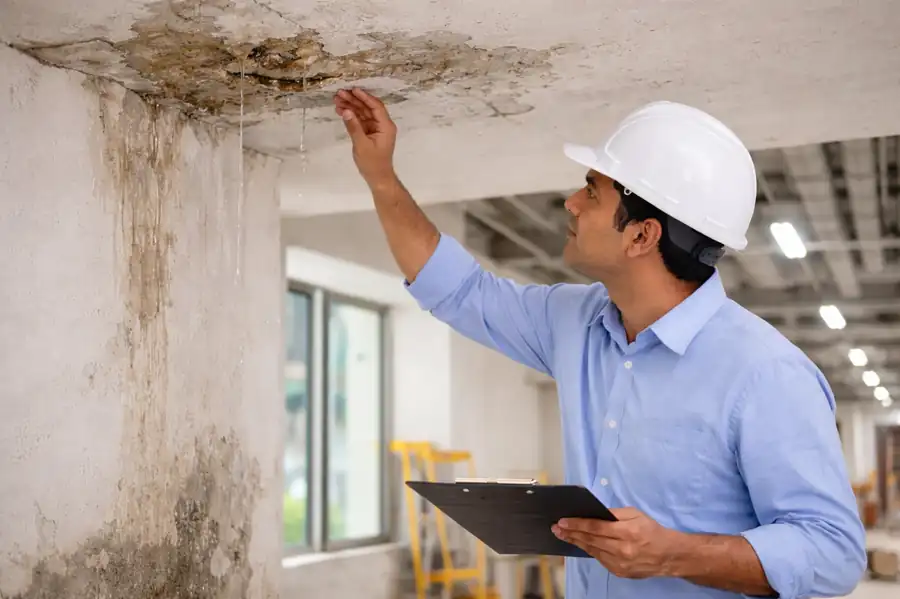
If joints are not properly sealed:
Water penetrates through joints
Dampness develops
Structural durability reduces
Waterproofing treatments are essential at joints.
Formation of Cracks at Joints
Improper joints often become points of stress concentration, leading to cracks.
Causes include:
Weak bonding
Differential shrinkage
Improper curing

Cracks further increase the risk of leakage and structural damage.
Lack of Waterstops in Critical Structures
In water-retaining structures such as basements and tanks, special materials called waterstops are used at joints to prevent leakage.
Common issues include:
Not providing waterstops
Incorrect installation
Damage during concreting
Without waterstops, joints become leakage points.
Poor Supervision During Joint Formation
Construction joints require careful supervision. However, on many sites:
Workers are unaware of proper procedures
Engineers do not inspect joint preparation
Work is rushed
This leads to poor-quality joints.
Impact on Structural Performance
Improper construction joints can lead to:
Reduced structural strength
Increased cracking
Water leakage issues
Reduced durability
These problems may not appear immediately but develop over time.
Role of Civil Engineers in Joint Management
Civil engineers must ensure proper planning and execution of construction joints.
Their responsibilities include:
Deciding correct joint locations
Ensuring proper surface preparation
Supervising application of bonding agents
Providing waterproofing measures
Proper management ensures structural continuity.
Real Site Scenario
In many projects, slab concreting is stopped midway without proper joint preparation. Later:
Leakage appears during rains
Cracks develop along joints
Repairs become necessary
These are common consequences of poor joint handling.
Preventive Measures
To avoid joint-related problems, engineers should:
Plan joint locations carefully
Roughen and clean surfaces before next pour
Use bonding agents
Provide waterstops in critical areas

These steps improve durability and performance.
Conclusion
Construction joints are unavoidable in most projects, but improper handling of these joints can lead to leakage, cracks, and structural weakness. Proper planning, surface preparation, and supervision are essential to ensure that joints perform effectively.
Civil engineers must treat construction joints as critical elements rather than routine interruptions. By following correct procedures and maintaining quality control, engineers can prevent long-term defects and ensure durable construction.
In real construction practice, a well-executed joint is as strong as the structure itself—but a poorly executed one becomes its weakest point.


Comments