
Why Concrete Strength on Site Does Not Match Laboratory Results
- Anjali Regmi
- Feb 7
- 4 min read

Introduction
Concrete strength is one of the most critical parameters in civil engineering projects. Designers assume that the characteristic strength achieved in laboratory-tested cubes will also be achieved in the actual structure. However, on real construction sites, engineers frequently encounter a troubling gap: cube test results look acceptable, but in-situ concrete performance tells a different story. Cracks appear early, rebound hammer values are inconsistent, and cores show lower-than-expected strength. Understanding why site concrete fails to match lab results is essential for preventing structural distress and ensuring long-term durability.

Difference Between Laboratory Conditions and Site Reality
Laboratory testing of concrete cubes is conducted under controlled conditions. Materials are accurately weighed, water-cement ratio is strictly maintained, compaction is uniform, and curing is ideal. In contrast, site conditions are dynamic and unpredictable. Variations in materials, workmanship, supervision, and environment significantly influence concrete strength. The lab result represents potential strength, while site concrete reflects actual execution quality.
Incorrect Water-Cement Ratio on Site
One of the most common reasons for strength loss is uncontrolled water addition. On site, extra water is often added to improve workability or ease placing, especially during hot weather or congested reinforcement. Even a small increase in water-cement ratio drastically reduces strength and increases permeability. While cubes may be cast using the correct mix, the concrete placed in structural members may contain excess water, leading to a mismatch between test results and in-situ performance.
Poor Batching and Mixing Practices
Accurate batching is critical to achieving designed concrete strength. In many projects using on-site mixers, volume batching is still practiced instead of weight batching. Variations in aggregate moisture content, cement quantity, and mixing time result in inconsistent concrete quality. Inadequate mixing leads to non-uniform distribution of cement paste, creating weak zones within the structure that are not reflected in cube tests prepared separately with more care.
Improper Compaction and Honeycombing
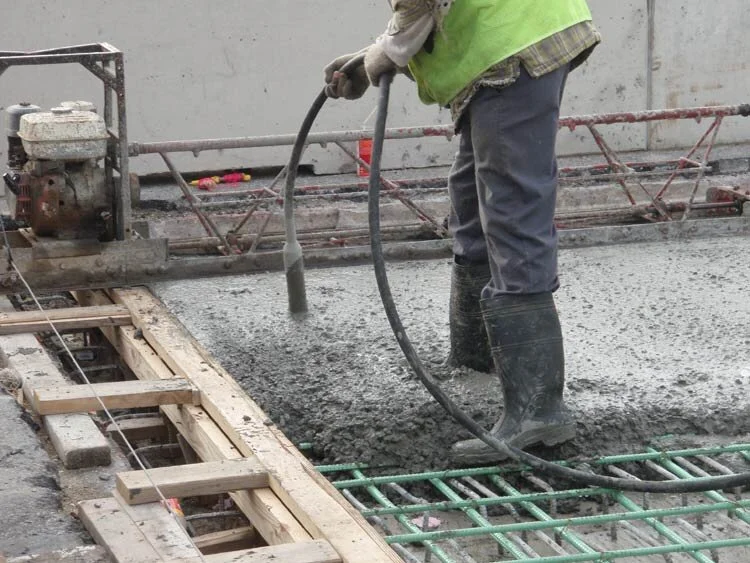
Laboratory cubes are compacted thoroughly using standard methods, ensuring minimal air voids. On site, compaction depends on vibrator condition, operator skill, and time available. Insufficient vibration causes honeycombing and entrapped air, reducing effective cross-sectional area and strength. Over-vibration, on the other hand, can cause segregation. These compaction-related defects weaken structural concrete but may not affect cube strength significantly.
Difference in Curing Conditions
Curing plays a vital role in strength development. In laboratories, cubes are cured in water tanks at controlled temperatures for specified durations. On site, curing is often irregular, insufficient, or prematurely stopped to meet deadlines. Slabs and beams exposed to sun and wind lose moisture rapidly, hindering hydration. Poor curing reduces actual strength and durability, even if cube test results appear satisfactory.
Delays Between Mixing, Transportation, and Placement
In ready-mix concrete operations, delays during transportation or placement can significantly affect workability and strength. Long transit times, traffic delays, and site congestion lead to initial setting before placement. Re-tempering concrete by adding water on site further degrades strength. While cubes may be cast immediately after arrival, the concrete placed in the structure may have already lost quality.
Poor Quality or Contaminated Aggregates
Aggregates constitute the bulk of concrete volume, and their quality directly affects strength. On site, aggregates may contain dust, clay, organic matter, or excess moisture. Improper storage allows contamination and segregation. Laboratory samples often use cleaned or representative aggregates, while site concrete may suffer from inferior material quality, reducing bond strength and overall performance.
Improper Cube Casting and Testing Practices
In some cases, cube test results themselves may not represent true concrete quality. Cubes may be improperly cast, inadequately compacted, or selectively sampled from better-quality concrete. Poor labeling, delayed testing, or manipulation of results further distort reality. Such practices create a false sense of compliance while actual structural concrete remains substandard.
Environmental Factors Affecting Concrete Strength
Temperature, humidity, and wind conditions influence concrete behavior significantly. Hot weather accelerates evaporation and hydration, increasing the risk of plastic shrinkage cracks and reduced strength. Cold conditions slow hydration, delaying strength gain. Laboratory environments do not reflect these extreme conditions, making site concrete more vulnerable if precautions are not taken.
Role of Site Supervision and Quality Control
The gap between lab and site strength often reflects weak supervision and quality control. Lack of proper checks on batching, water addition, compaction, and curing allows deviations to go unnoticed. Effective quality control requires continuous monitoring, not just periodic testing. Engineers who actively supervise concreting operations significantly reduce strength variability.
How Engineers Can Ensure Site Concrete Matches Design Strength
Ensuring strength consistency requires strict control over mix design implementation, proper training of workers, calibrated equipment, and disciplined curing practices. Using checklists before and during concreting, limiting unauthorized water addition, and verifying compaction quality are practical measures. Non-destructive testing and core sampling help assess in-situ strength realistically and guide corrective action.
Conclusion
When concrete strength on site does not match laboratory results, the issue is rarely mysterious. It is the outcome of deviations in execution, supervision, and environmental control. Laboratory cubes indicate what concrete can achieve; site performance shows what it actually achieves. For civil engineers, bridging this gap is a matter of professional responsibility. Strong structures are built not just in laboratories, but through disciplined execution on real construction sites.


Comments