
Surveying Errors in Construction: How Small Measurement Mistakes Lead to Major Structural Problems
- Anjali Regmi
- Mar 4
- 3 min read

Surveying is one of the most fundamental activities in civil engineering projects. Before any excavation, foundation work, or structural construction begins, accurate measurements and layout markings are required. Despite its importance, surveying errors are among the most common causes of structural misalignment, dimensional inaccuracies, and expensive rework on construction sites.
In real construction environments, even a small mistake in leveling, alignment, or coordinate marking can affect the entire project. A few millimeters of deviation during layout may later result in tilted columns, uneven floors, or misaligned structural elements.
Why Surveying is Critical in Construction
Surveying ensures that structures are built exactly according to the design drawings and coordinates defined by engineers and architects. It establishes reference points, levels, and boundaries that guide every stage of construction.
Without accurate surveying:
Foundations may be misaligned
Structural elements may shift from their designed position
Building dimensions may deviate from plans
Common Surveying Errors on Construction Sites
Incorrect Benchmark Establishment
A benchmark is the reference point for all level measurements on site. If the benchmark is incorrect, every subsequent level measurement becomes inaccurate.
Misplacement of Layout Points
Errors in marking foundation or column positions cause structural elements to shift from their intended locations.
Improper Level Measurement
Incorrect use of leveling instruments leads to uneven floor levels and misaligned structural components.
Real Causes of Surveying Mistakes
Inexperienced surveyors or engineers
Poor calibration of surveying instruments
Lack of cross-verification of measurements
Working under time pressure
Ignoring environmental factors such as vibration or unstable ground

Structural Consequences of Surveying Errors
Surveying mistakes often lead to serious construction problems, including:
Misaligned columns and beams
Uneven slab levels
Incorrect building orientation
Structural clashes between elements
Difficulty during finishing works
These issues may require demolition and reconstruction to correct.
Column Misalignment: A Common Surveying Problem
If column layout points are not accurately marked, columns may tilt or shift from the designed grid. This creates alignment problems for beams, slabs, and walls in upper floors.
Such errors propagate through the entire structure and become increasingly difficult to fix at later stages.

Importance of Control Points and Grid Systems
Control points and grid lines are established to maintain consistent alignment throughout the construction process. These reference systems ensure that structural elements are positioned accurately as the building progresses vertically.
Without proper grid control, dimensional deviations accumulate at each construction stage.
Surveying Instruments Used in Modern Construction
Civil engineers use various instruments to ensure measurement accuracy:
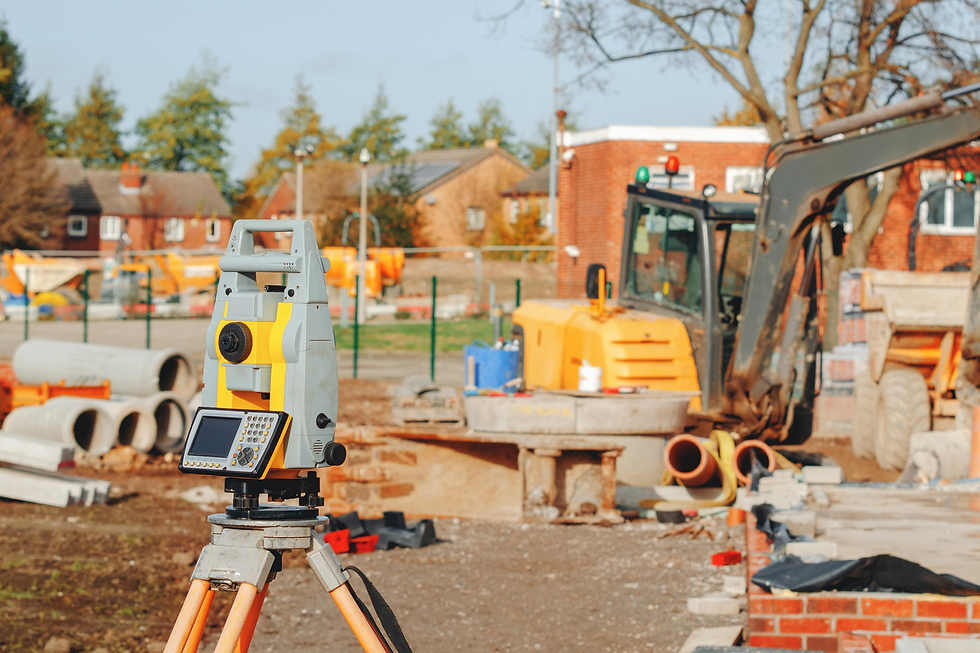
Total Station – precise coordinate measurement
Auto Level – elevation and leveling checks
Theodolite – angular measurement
GPS Survey Equipment – large-scale site mapping
Proper calibration and correct usage of these instruments are essential for accurate results.

Preventive Measures to Avoid Surveying Errors
Cross-Verification of Measurements
Always verify layout points and levels with multiple readings.
Proper Instrument Calibration
Surveying instruments must be regularly calibrated to maintain accuracy.
Clear Benchmark Establishment
Benchmarks should be protected and rechecked periodically.
Use of Experienced Surveyors
Qualified personnel should handle critical surveying tasks.
Role of Civil Engineers in Survey Verification
Site engineers must supervise surveying activities rather than relying entirely on survey teams. Verification of layout points, levels, and grid lines before construction ensures accuracy and prevents costly mistakes.
Impact of Surveying Errors on Project Cost and Schedule
Surveying mistakes can cause:
Demolition and reconstruction
Delay in structural works
Increased labor and material costs
Difficulty in installing architectural finishes
Correcting layout errors becomes more difficult as construction progresses.
Modern Technologies Improving Survey Accuracy
Technologies such as drone surveying, laser scanning, and 3D modeling provide highly accurate site measurements. These tools help engineers detect potential alignment issues before construction begins.
However, traditional field verification remains essential even with advanced technology.
Conclusion: Accurate Surveying is the Foundation of Precise Construction
Surveying errors may appear small initially, but they can create serious structural problems if left unchecked. Accurate layout, leveling, and alignment ensure that the building is constructed exactly as designed.
Civil engineers who prioritize measurement accuracy, verify surveying data, and supervise layout work prevent costly rework and structural misalignment. In real construction practice, precise surveying is not just a technical task — it is the foundation of reliable and high-quality construction.


Comments