
Silent Revolution: How Robotics Are Replacing Traditional Construction Work

The construction industry has long been known as one of the most labor-intensive sectors in the world. For centuries, buildings, bridges, highways, tunnels, and other infrastructure projects have relied heavily on manual labor, skilled craftsmanship, and physically demanding work. However, a major transformation is quietly taking place. Across the globe, robotics and automation technologies are gradually reshaping the construction sector, introducing a new era where machines increasingly handle tasks that were traditionally performed by humans. This “silent revolution” is not happening overnight, but its impact is becoming impossible to ignore.

Construction has historically been slower to adopt automation compared to industries such as manufacturing and automotive production. The primary reason is the complexity and unpredictability of construction sites. Unlike factories, where robots work in controlled environments performing repetitive tasks, construction projects involve constantly changing surroundings, varying weather conditions, and unique design requirements. Despite these challenges, advances in robotics, artificial intelligence, machine learning, and sensor technology are making automation more practical than ever before.
One of the most visible examples of robotics in construction is the use of autonomous construction equipment. Traditional heavy machinery such as bulldozers, excavators, and dump trucks are now being developed with self-driving capabilities. Companies like Caterpillar and Komatsu have introduced autonomous vehicles capable of performing excavation, grading, and material transportation with minimal human intervention. These machines use GPS systems, sensors, and advanced software to navigate construction sites accurately while improving efficiency and reducing accidents caused by human error.
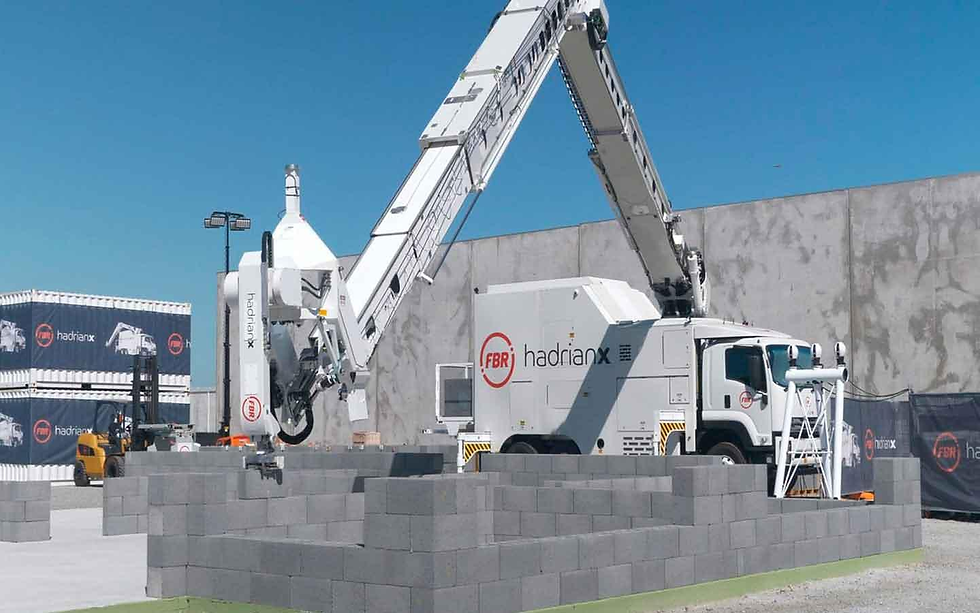
Another major advancement is robotic bricklaying. Bricklaying is a physically exhausting and time-consuming process that requires precision and consistency. Robotic systems such as Hadrian X by FBR have demonstrated the ability to lay thousands of bricks in a single day, significantly outperforming human workers in speed. These robots use computer-guided systems to place bricks accurately according to digital building plans. By reducing manual labor requirements, construction companies can complete projects faster while maintaining higher levels of consistency and structural accuracy.

Concrete printing, often referred to as 3D construction printing, is another groundbreaking development changing the industry. Instead of workers manually mixing concrete, building molds, and pouring materials, robotic printers can construct walls and structural components layer by layer directly from digital designs. Companies like ICON Build are using large-scale 3D printers to build affordable homes within days rather than months. This technology reduces material waste, lowers labor costs, and opens possibilities for constructing buildings in remote or disaster-affected areas where traditional construction methods may be difficult.
Demolition work is also becoming increasingly automated. Traditionally, demolition is one of the most dangerous jobs in construction because workers must operate in unstable environments surrounded by heavy debris and dust. Robotic demolition machines can now perform these hazardous tasks remotely. Companies such as Brokk Global manufacture demolition robots that can break concrete walls, remove structures, and handle dangerous materials while operators control them from a safe distance. This significantly improves worker safety while increasing precision during demolition projects.
Robotics is also transforming construction site inspection and monitoring. Drones equipped with cameras, sensors, and AI-based software are increasingly being used to survey construction sites. These aerial robots can inspect progress, detect design deviations, monitor worker safety compliance, and create accurate 3D maps of project areas. Companies such as DJI have developed drones widely used in infrastructure projects worldwide. Compared to manual inspections, drones save time, reduce surveying costs, and provide highly detailed data that helps engineers make faster decisions.
Material handling is another area where robotics is replacing traditional labor. Construction workers spend significant time transporting materials across project sites. Automated robotic carriers and robotic arms can now move heavy materials more efficiently than manual laborers. In large warehouses supporting construction operations, robotic systems organize inventory, transport steel components, and prepare materials for installation. This reduces physical strain on workers while improving overall productivity.
Welding and steel fabrication have also seen major automation improvements. Robotic welding systems can perform repetitive welding tasks with exceptional accuracy. In large infrastructure projects involving steel structures such as bridges and industrial buildings, automated welding reduces defects caused by fatigue or inconsistency. This leads to stronger structures and lower maintenance requirements in the future.
Safety is perhaps one of the strongest reasons behind adopting robotics in construction. Construction consistently ranks among the world’s most dangerous industries, with workers exposed to falls, machinery accidents, electrical hazards, toxic materials, and extreme environmental conditions. Robots can take over high-risk tasks such as working at dangerous heights, handling hazardous chemicals, entering confined underground spaces, or operating heavy machinery in unstable environments. By reducing direct human exposure, robotics has the potential to dramatically lower workplace injuries and fatalities.
Despite these advantages, the growing use of robotics raises concerns about job displacement. Many workers fear that machines will replace traditional construction jobs entirely. However, experts believe the situation is more complex. While repetitive and physically demanding roles may decline, new job opportunities are emerging in robot maintenance, programming, machine supervision, data analysis, and digital construction management. Instead of eliminating workers completely, the industry is shifting toward a workforce that combines engineering knowledge with technological skills.
For civil engineers, this transformation means future professionals must learn beyond traditional structural design and construction techniques. Knowledge of automation systems, digital modeling, robotics integration, and technologies like Building Information Modeling (Autodesk BIM 360) is becoming increasingly valuable. Universities are slowly adapting their curriculums to prepare students for this rapidly evolving environment.
Another important factor driving robotics adoption is labor shortages. Many countries are experiencing declining interest in physically demanding construction jobs among younger generations. Aging workforces and rising labor costs are forcing companies to explore automation as a long-term solution. Robotics helps maintain productivity even when skilled labor availability decreases.
The future of construction may involve fully automated building sites where robots perform excavation, printing, assembly, welding, inspection, and finishing work with minimal human presence. Smart cities, sustainable infrastructure, and mega engineering projects will increasingly depend on automated technologies to meet growing demand efficiently.
The revolution happening in construction today may seem quiet compared to dramatic technological changes in other industries, but its long-term consequences are enormous. Robotics is not simply improving construction efficiency it is fundamentally redefining how infrastructure is built. Traditional construction methods that have existed for generations are being challenged by intelligent machines capable of working faster, safer, and more precisely.
In the coming decade, the relationship between humans and machines in construction will continue to evolve. Rather than replacing engineers completely, robotics will transform the role of construction professionals. Those who adapt to this technological shift will lead the future of the industry, while those who resist may struggle to remain competitive. The silent revolution has already begun, and construction will never be the same again.


Comments