
How Artificial Intelligence Is Changing Construction Site Management
- Anjali Regmi
- Jun 12
- 5 min read

The construction industry has traditionally been known for its reliance on manual labor, experience-based decision-making, and complex project coordination. However, the rapid advancement of Artificial Intelligence (AI) is transforming the way construction projects are planned, monitored, and executed. In 2026, AI has become one of the most influential technologies in construction site management, helping companies improve productivity, enhance safety, reduce costs, and deliver projects more efficiently.

As construction projects become increasingly complex, AI-powered tools are enabling site managers to make data-driven decisions, predict potential issues before they occur, and streamline operations in ways that were previously impossible. From intelligent scheduling systems to AI-driven safety monitoring, the technology is reshaping construction site management across the globe.
Understanding AI in Construction
Artificial Intelligence refers to computer systems that can perform tasks typically requiring human intelligence, such as learning, problem-solving, decision-making, and pattern recognition. In construction site management, AI processes large volumes of data collected from sensors, drones, cameras, project management software, and machinery to provide valuable insights.
Unlike traditional software that follows fixed instructions, AI continuously learns from data and improves its performance over time. This capability allows construction managers to optimize workflows, anticipate challenges, and improve project outcomes.
Improving Project Planning and Scheduling
One of the most significant applications of AI in construction site management is project planning and scheduling. Construction projects often involve hundreds of interconnected tasks, making scheduling extremely challenging.
AI-powered scheduling tools analyze historical project data, weather forecasts, labor availability, equipment usage, and material delivery schedules to create optimized project timelines. These systems can identify potential delays before they occur and recommend alternative schedules to keep projects on track.
For example, if AI detects that a critical material shipment may arrive late, it can automatically adjust the project schedule and suggest alternative tasks that workers can complete in the meantime. This proactive approach minimizes downtime and improves resource utilization.
As a result, project managers can make faster and more informed decisions while maintaining better control over project deadlines.
Enhancing Construction Site Safety
Safety remains one of the biggest concerns in the construction industry. Construction sites are inherently hazardous environments where accidents can result in injuries, fatalities, project delays, and financial losses.
AI is significantly improving safety management through advanced monitoring systems. AI-powered cameras and computer vision technology can continuously monitor construction sites and identify unsafe behaviors in real time.
These systems can detect:
Workers not wearing personal protective equipment (PPE)
Employees entering restricted zones
Unsafe equipment operation
Fall hazards
Potential collision risks
When an unsafe condition is detected, site managers receive immediate alerts, allowing them to take corrective action before an accident occurs.
AI can also analyze historical safety records to identify patterns and predict areas where accidents are more likely to happen. This predictive capability helps organizations implement preventive measures and create safer working environments.
Real-Time Site Monitoring Through Drones
Drones equipped with AI technologies have become powerful tools for construction site management. These unmanned aerial vehicles can capture high-resolution images, videos, and site data in a fraction of the time required for manual inspections.
AI algorithms analyze drone-generated data to monitor project progress, compare actual work against project plans, and identify discrepancies. Site managers can obtain accurate updates without physically inspecting every section of the project.
Drone-based AI systems help with:
Progress tracking
Site surveying
Earthwork measurements
Structural inspections
Quality control assessments
This technology improves accuracy while reducing the time and costs associated with traditional site inspections.

Predictive Maintenance of Equipment
Construction projects rely heavily on machinery such as excavators, cranes, bulldozers, and concrete mixers. Equipment breakdowns can cause significant delays and increase project costs.
AI-powered predictive maintenance systems monitor equipment performance using sensors that collect data on temperature, vibration, fuel consumption, and operating conditions. By analyzing this information, AI can predict when equipment is likely to fail.
Instead of waiting for a breakdown, maintenance teams can service machinery before problems occur. This approach reduces downtime, extends equipment lifespan, and lowers maintenance expenses.
Predictive maintenance also improves safety by ensuring that machinery remains in optimal working condition throughout the project lifecycle.
Better Resource Management
Managing labor, materials, and equipment efficiently is essential for successful construction site management. AI helps optimize resource allocation by analyzing project requirements and available resources.
For example, AI systems can determine:
The number of workers needed for specific tasks
The most efficient equipment deployment strategy
Material consumption rates
Inventory requirements
These insights help reduce waste, prevent shortages, and improve productivity. Construction companies can save significant costs by ensuring that resources are used efficiently and only when needed.
Quality Control and Defect Detection
Quality control is critical in construction because defects can lead to costly repairs, delays, and safety concerns. AI-powered image recognition systems are improving quality assurance processes by identifying defects that may be difficult for humans to detect.
Using photographs, videos, and sensor data, AI can inspect construction work and identify issues such as:
Cracks in structures
Improper installations
Surface irregularities
Material defects
Structural inconsistencies
Early detection allows construction teams to address problems before they become serious, reducing rework costs and improving overall project quality.
AI-Powered Building Information Modeling (BIM)
Building Information Modeling (BIM) has become an essential tool in modern construction, and AI is making BIM systems even more powerful.
AI-enhanced BIM platforms can analyze design models, construction schedules, and site conditions to identify potential conflicts before construction begins. This capability helps reduce errors, avoid costly modifications, and improve coordination among project stakeholders.
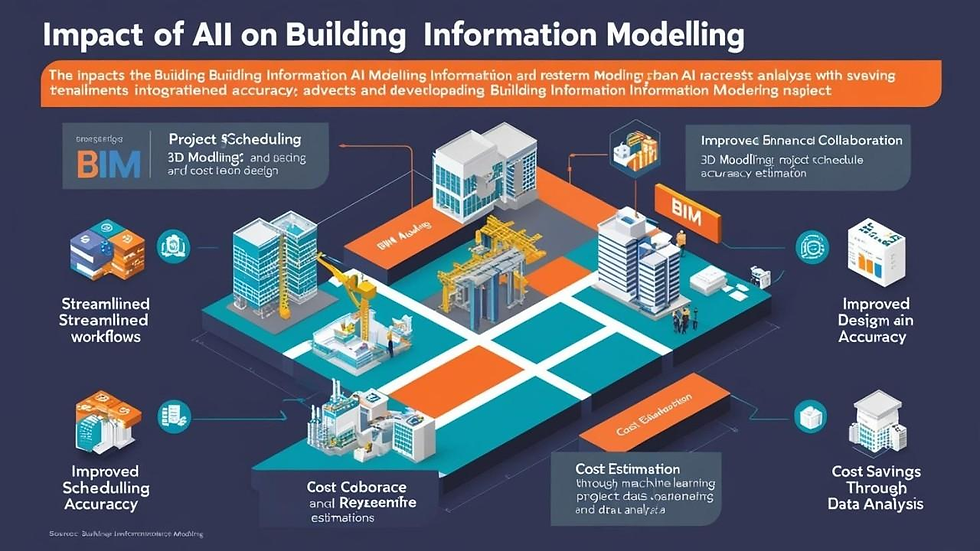
AI-integrated BIM systems can also simulate construction scenarios, allowing project managers to evaluate different approaches and select the most efficient solution.
The combination of AI and BIM creates a more intelligent and collaborative construction management environment.
Improving Cost Estimation and Budget Control
Accurate cost estimation is essential for project success. Traditional estimation methods often rely on experience and historical data, which may not always account for changing project conditions.
AI-powered estimation tools analyze large datasets from previous projects, market trends, labor costs, material prices, and project specifications to generate highly accurate cost predictions.
These systems help project managers:
Prepare realistic budgets
Identify potential cost overruns
Monitor expenses in real time
Improve financial planning
By providing better financial visibility, AI enables construction companies to maintain profitability while reducing budget-related risks.
Workforce Productivity Enhancement
AI is helping construction managers improve workforce productivity through data-driven performance analysis. By monitoring work progress and labor efficiency, AI systems can identify bottlenecks and recommend process improvements.
For example, AI can determine:
Which tasks are taking longer than expected
Areas where workers require additional training
Opportunities to improve workflow efficiency
Optimal crew assignments
These insights help managers maximize productivity while ensuring that projects remain on schedule.
The Future of AI in Construction Site Management
The role of AI in construction site management will continue to expand as technologies become more sophisticated. Future developments may include autonomous construction equipment, fully AI-managed project scheduling, robotic construction assistants, and advanced digital twins that simulate entire construction projects in real time.
As machine learning algorithms become more accurate and accessible, even small and medium-sized construction firms will be able to leverage AI-driven solutions. The integration of AI with emerging technologies such as the Internet of Things (IoT), robotics, augmented reality, and 5G connectivity will further revolutionize construction site operations.
Conclusion
Artificial Intelligence is fundamentally transforming construction site management by improving planning, safety, productivity, quality control, equipment maintenance, and resource allocation. Through real-time monitoring, predictive analytics, and intelligent decision-making, AI helps construction companies complete projects faster, safer, and more cost-effectively.
As the construction industry embraces digital transformation, AI is no longer a futuristic concept but a practical tool that is delivering measurable benefits on construction sites worldwide. Organizations that adopt AI-driven site management strategies today will be better positioned to compete in the increasingly technology-driven construction landscape of the future.


Comments