
Cable Tray and Pipe Support Failures in Industrial Structures: Causes Engineers Often Overlook
- Anjali Regmi
- Feb 10
- 4 min read

Introduction
In industrial buildings, power plants, refineries, factories, and large commercial facilities, cable trays and pipe supports are critical secondary structural systems. Although they do not form part of the main load-bearing frame, their failure can cause serious safety hazards, operational shutdowns, and structural damage. In real projects, many cable tray and pipe support failures occur not due to overload alone, but because of poor load assessment, improper anchorage, vibration effects, and execution-level negligence. These failures are frequently underestimated during design and treated casually during construction.

Importance of Cable Tray and Pipe Support Systems
Cable trays and pipe supports carry dead loads of services, live loads due to fluid movement, thermal expansion forces, and dynamic effects from vibration. In industrial environments, these systems often run continuously over long spans and are attached to slabs, beams, columns, or steel frames. Failure of these supports can lead to falling services, leakage of hazardous fluids, electrical faults, fires, and even secondary structural damage.
Despite this risk, support systems are often designed with minimal margins and executed without rigorous inspection.
Underestimation of Actual Service Loads
One of the most common causes of failure is incorrect load estimation. Designers may consider only the self-weight of empty pipes or cable trays, ignoring the weight of fluids, insulation, cable filling percentage, future service additions, and maintenance loads. Over time, trays and pipes become heavily congested as new services are added, significantly increasing loads beyond original assumptions.
This gradual overloading leads to excessive deflection, bolt failure, and eventual collapse.
Failure to Consider Dynamic and Vibration Effects
Industrial services are rarely static. Flowing fluids, pumps, compressors, and rotating machinery introduce vibrations that cyclically load supports. When vibration effects are ignored, fatigue failure occurs in bolts, welds, and anchors. Small cracks propagate over time, leading to sudden failure without visible warning.
Supports located near heavy machinery are especially vulnerable if vibration isolation is not provided.

Improper Selection and Installation of Anchors
Anchors connect cable trays and pipe supports to concrete or steel structures. In many failures, anchor capacity is grossly overestimated. Common mistakes include using wrong anchor type, insufficient embedment depth, poor drilling quality, and inadequate edge distances. Chemical anchors may be installed without proper hole cleaning or curing time, reducing bond strength.
Once an anchor fails, load redistributes to adjacent supports, often causing progressive collapse.
Inadequate Spacing and Unsupported Spans
Support spacing is often increased on site to reduce material cost or ease installation. Longer unsupported spans significantly increase bending stresses in trays and pipes. Over time, sagging becomes visible, connections loosen, and failure occurs. In piping systems, excessive span length also increases stress due to thermal expansion and fluid weight.
These spacing changes are rarely recalculated, making them silent but dangerous deviations.
Corrosion and Environmental Degradation
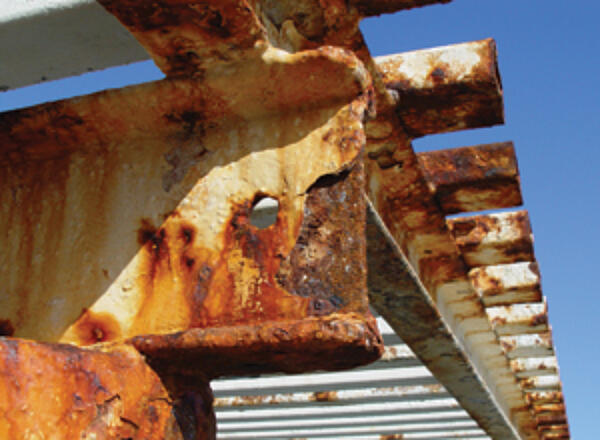
Industrial environments expose supports to moisture, chemicals, heat, and corrosive fumes. Lack of protective coatings, damaged galvanization, or poor drainage accelerates corrosion. Corroded supports lose cross-sectional area, reducing load capacity. Corrosion at anchor points is particularly dangerous because it weakens the entire load transfer system.
Thermal Expansion and Movement Constraints
Pipes expand and contract with temperature changes. If supports restrain this movement without allowing flexibility, thermal forces build up in pipes and supports. This leads to buckling, cracking at supports, or anchor pull-out. In many failures, rigid supports are provided where sliding or guided supports were required.
Thermal movement is often underestimated or completely ignored during detailing.
Poor Coordination Between Structural and MEP Teams
Cable trays and pipes are often designed by MEP teams but supported by structural elements. Lack of coordination results in supports being fixed to weak slabs, thin beams, or non-structural elements not designed for these loads. Unauthorized drilling into structural members further weakens them and creates safety risks.
Failures frequently occur at locations never intended to carry service loads.
Warning Signs Engineers Commonly Miss
Early signs of failure include sagging trays, tilted supports, cracked concrete around anchors, unusual vibrations, and audible noises during operation. These signs are often ignored as “service issues” rather than structural warnings. By the time corrective action is taken, failure may already be imminent.
Engineering Measures to Prevent Support Failures
Preventing failures requires accurate load assessment, including future service allowance and dynamic effects. Proper anchor selection, spacing checks, corrosion protection, and vibration isolation are essential. Supports must be detailed to accommodate thermal movement, not restrain it. Regular inspection and maintenance significantly reduce risk.
Mock-up testing and proof load testing of anchors provide additional assurance in critical installations.
Role of Civil Engineers in Service Support Safety
Civil engineers must recognize that cable trays and pipe supports are structural systems in their own right. Reviewing load paths, approving support locations, and inspecting anchor installations are critical responsibilities. Treating service supports as “minor works” often leads to major failures.
Conclusion
Cable tray and pipe support failures are not rare accidents—they are predictable outcomes of underestimated loads, poor anchorage, vibration neglect, and weak coordination. In industrial structures, the consequences of such failures extend far beyond repair cost, affecting safety, operations, and environmental risk. For civil engineers, ensuring the integrity of service support systems is an essential part of delivering safe, functional, and durable industrial facilities.


Comments